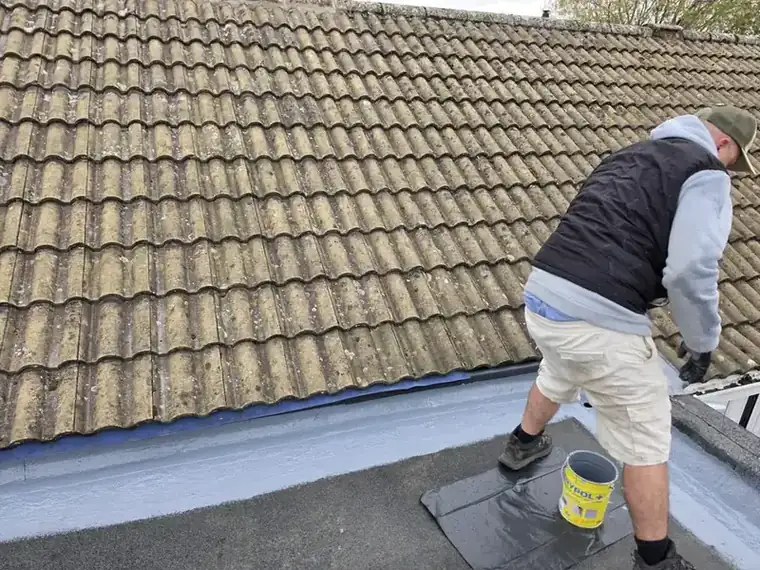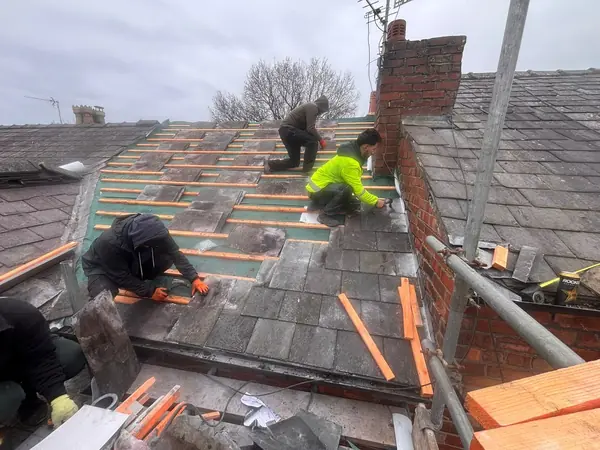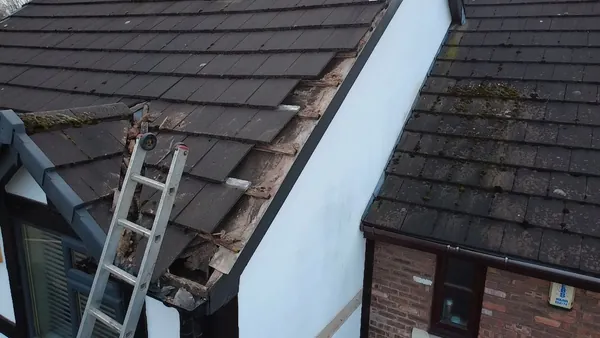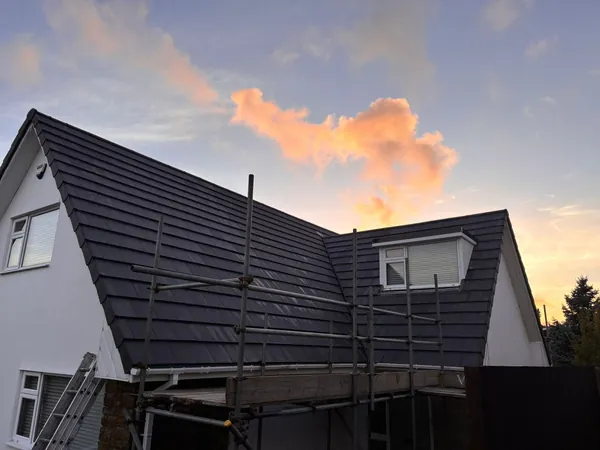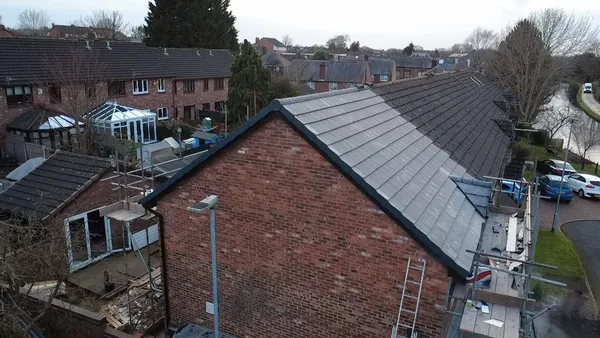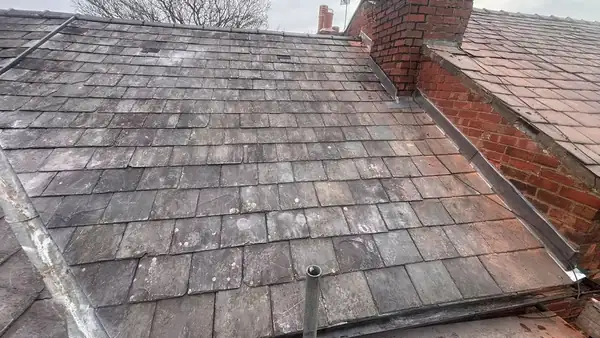
Plenty of Chester houses have a roof that looks like slate from the pavement but isn't. Between the late 1970s and the early 2000s, thousands of UK homes were covered or re-covered in man-made fibre-cement slates, sold under names like Eternit and fitted because they cost a fraction of Welsh slate and went on quickly. Most of those roofs are now 25 to 45 years old, which is right where the material starts to give up. The tell-tale signs are edges that split into layers, corners lifting, colour washing out to a chalky grey, and slates sliding down when the copper rivet at the tail lets go. Older ones come with a second question, because anything made before the UK's asbestos ban in November 1999 could contain asbestos fibres. Below: how to tell what you've got, when the asbestos question changes the job, and what a repair or a full re-roof costs around Chester in 2026.
How to Tell If Your Chester Roof Has Fibre-Cement Slates
Stand across the road with a pair of binoculars and look at the bottom edge of each slate. Natural slate varies. Thicknesses differ from one slate to the next, the edges are slightly ragged where they were dressed, and the surface has a faint sheen when the light catches it. Fibre-cement slates are machine-made, so every one is the same size, the same thin 4mm or so, with dead-straight edges and square corners. The roof reads as a flat, even grid.
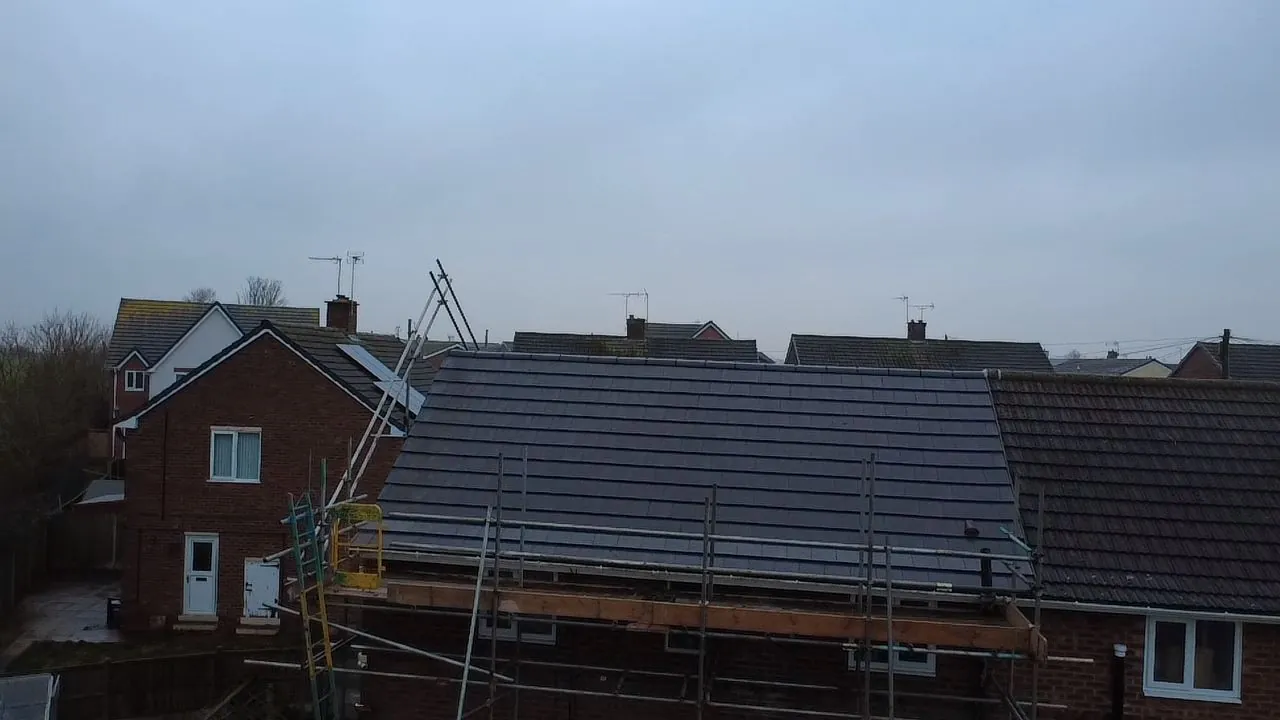
The giveaway, though, is the rivet. Most fibre-cement slates are held at the tail by a copper disc rivet: a small round disc sitting under the joint between the two slates below, with a stem poking up through a hole near the slate's bottom edge. From the ground you'll see a neat line of small copper or green dots, one centred at the foot of each slate. Natural slate is nailed near the head or centre and doesn't need a tail rivet, so a roof full of them is almost always man-made.
Inside the loft, if the underside of the slates is visible between the battens, look for printed batch codes. Some later non-asbestos products carry an "NT" mark, short for non-asbestos technology, though a missing stamp proves nothing either way. If you're unsure what's on your house, our slate roof team can identify it from a short inspection, usually without lifting a single slate.
When Were Your Slates Made? Dating Them Matters
Age is the first thing to pin down, because it tells you how much life is left and whether asbestos is a realistic possibility. In Chester, fibre-cement slates turn up in three common situations.
- Victorian and Edwardian terraces whose original Welsh slate was stripped in the 1970s, 80s or 90s and replaced with something cheaper. In a row of matching roofs, the odd one out is often this.
- Houses and bungalows built from the late 1970s onwards that were specified with artificial slate from new, particularly where a lightweight covering suited the trussed rafters.
- Dormers, porches, garages and rear extensions added to older houses, where a builder wanted a slate look without the weight or the cost.
UK manufacturers moved away from asbestos gradually through the 1980s and 1990s, and there is no single changeover date for every brand. The legal end point is clear, though. White asbestos was banned in the UK from 24 November 1999, so slates made after that date shouldn't contain it. Anything earlier could go either way. If you bought the house with a survey, check it, as surveyors often note "artificial slate" and sometimes give an approximate date. Old building control records or planning drawings can help with an extension.
Delamination, Curling, Fading and Failing Rivets
Fibre-cement slates rarely fail all at once. The roof wears out a few slates at a time, and the pattern gives away how far it has gone.
Delamination
The slate is made in thin compressed layers. Once the surface coating wears through, damp gets between those layers, and every frost pushes them apart a little further. You'll see the exposed edges flaking like pastry, then whole patches of surface peeling off. Early non-asbestos slates from the late 1980s and 1990s have a reputation among roofers for doing this sooner than the products before or since, and Chester's damp winters, when the slopes often stay wet for days at a time, give the frost plenty to work with.
Curling and bowing
As the layers loosen, slates lose their stiffness. Corners lift, tails turn up or down, and the roof surface looks wavy in low sun. A curled slate lets wind-driven rain under the lap, and a strong westerly can catch a raised corner and snap it off.
Fading
New fibre-cement slates are dark blue-grey. After 20 years or more they fade towards a pale, chalky grey, sometimes with white streaks or a furry coat of moss and lichen. Fading on its own is cosmetic. It does tell you the protective coating has gone, and delamination usually follows.
Rivet and nail failure
Each slate depends on two nails at the top and the disc rivet at the bottom. When the slate weakens, the rivet stem can tear through the softened edge, or the slate cracks across the rivet hole. Either way it slides down until it catches on the slates below, or drops into the gutter. One slipped slate is a repair. A new one every few months, scattered across different slopes, usually means the whole covering is reaching the end.
Pre-2000 Slates and Asbestos: What It Means for Repairs and Removal
If your slates could date from before the ban, treat them as containing asbestos until a test says otherwise. That isn't cause for panic. Asbestos cement is a bonded material, with the fibres locked into the cement, and while it's intact and left alone the risk is low.
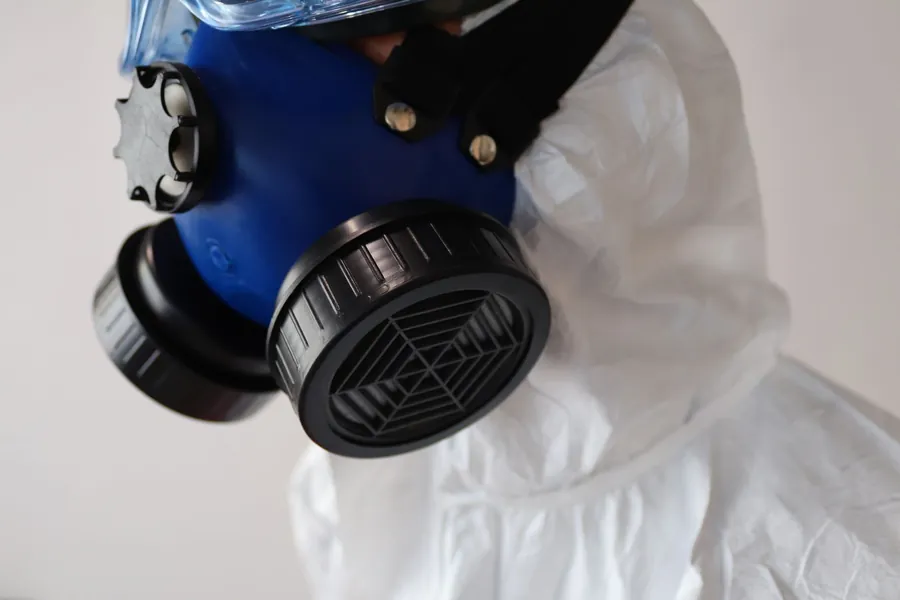
The HSE's guide to where asbestos is found and how to deal with each material places asbestos cement among the lower-risk products. Work on it is generally done by trained workers without a licence, but it becomes notifiable where the job would cause significant break-up of the material, and badly damaged cement may need a licensed contractor. Its Asbestos essentials task sheets set out the methods, which come down to keeping the material whole and damp and never cutting, drilling or breaking it.
In practice, on a Chester roof, that means:
- No jet-washing to shift moss. It blasts the weathered surface off, fibres and all.
- No angle grinders. Slates are taken off whole, not smashed off the battens.
- Removed slates are wetted, wrapped or bagged and taken to a site licensed for hazardous waste, not tipped in a skip.
- Householders can't simply drop them at the tip. Cheshire West and Chester Council's Chester recycling centre page says the Bumpers Lane site doesn't accept asbestos.
A lab test on a small sample costs roughly £40 to £100, depending on whether you post it yourself or have a surveyor take it. Do that before you get re-roofing quotes, so every roofer prices the same job.
Repair or Re-Roof a Fibre-Cement Slate Roof?
Here's the awkward part. Unlike natural slate, which can be stripped, sorted and partly reused, a worn fibre-cement roof has nothing worth salvaging. And every repair visit risks a few more breakages, because brittle old slates crack under a roof ladder or a knee.
If the roof is under about 25 years old, the slates are still stiff and dark, and the trouble is a handful of slipped slates after one bad storm, repair it. The same goes if the felt underneath is sound and the loft stays dry. Spending £10,000 on a roof with a decade or more left in it makes no sense.
A re-roof is usually the better money when:
- more than roughly one slate in ten shows flaking edges or curl
- slates have slipped on more than one slope within a year or so
- the old bitumen felt underneath is brittle or torn, so every slipped slate turns into a leak
- the slates are pre-2000 and untested, and repeated repairs mean repeatedly disturbing possible asbestos
A repair means sliding a new slate into place and holding it with a stainless steel hook or a copper strip, since you can't nail through the course above. Matching is rarely perfect. Sizes have changed over the years, and a new slate stands out dark against a faded roof for a while before it weathers in. We go through the wider decision, beyond this one material, in our guide to deciding between roof repair and replacement in Chester.
Replacement Options: Natural Slate, New Fibre Cement or Slate-Effect
If the roof is coming off, you aren't tied to the same material. There are three realistic routes.
New fibre-cement slates
Today's products are asbestos-free and better made than the 1990s generation, and they're still fixed with copper disc rivets. They're the lightest option at roughly 18 to 22kg per square metre and the quickest to lay. Expect 30 years or so. They make most sense on a modern house with a trussed roof that was designed for a light covering.
Natural slate
Spanish slate is the most common choice; good Welsh slate costs more but outlasts everything else on this list. Both are heavier than fibre cement, typically 25 to 35kg per square metre. On a Victorian terrace that was built for Welsh slate in the first place, that's a return to the original load. On a newer roof designed around artificial slate, a structural check comes first, and a significantly heavier covering brings in Building Regulations approval through Cheshire West and Chester's building control. Inside a conservation area, putting natural slate back on a terrace that lost it is the change planners are least likely to argue with.
Slate-effect tiles
Thin-edged interlocking concrete tiles and composite slates made from recycled materials give a slate look at a lower price. The concrete versions are much heavier, often 45kg per square metre or more, so the timbers need checking. Composite slates are light but relatively new, so long-term performance is still unproven. For a side-by-side look at weights, lifespans and conservation rules across every main covering, see our comparison of slate, clay and concrete roofing materials.
Whichever you pick, replacing more than a quarter of the roof normally means bringing the loft insulation up to current standards too, so allow for it in the budget.
What Fibre-Cement Slate Work Costs in Chester in 2026
These are typical 2026 prices for a three-bedroom semi in and around Chester, with about 75 to 85 square metres of pitched roof. Terraces with tight access, steep slopes or a pavement scaffold licence will sit higher.

- Refixing one to three slipped slates with hooks or copper strips: £150 to £300
- Replacing 10 to 20 damaged slates in one visit: £350 to £750
- Asbestos test on a sample: £40 to £100
- Strip and re-roof in new fibre-cement slate, including membrane, battens and ridge: £7,000 to £9,500
- Strip and re-roof in slate-effect interlocking concrete tiles: £7,500 to £10,000
- Strip and re-roof in Spanish natural slate: £9,500 to £13,500
- Strip and re-roof in new Welsh slate: £14,000 to £19,000
- Extra for removing and disposing of asbestos-cement slates properly: £1,200 to £2,800
- Scaffolding alone, if not included: £800 to £1,500
The asbestos line is the one that catches people out. Get it tested first and ask each roofer to show disposal as a separate item, so you can see who has priced it properly and who has quietly left it out.
Fibre-Cement Slate Questions From Chester Homeowners
How long do fibre-cement slates last?
Usually 25 to 35 years. Some from the late 1980s and 1990s fail sooner, mostly through delamination. Today's products should manage around 30 years, and good natural slate typically lasts three times as long or more.
Do asbestos fibre-cement slates have to be removed?
No. There's no legal requirement for a homeowner to remove asbestos cement slates that are intact. Left alone, they pose a low risk. They need careful handling when they're repaired, removed or start breaking up, and that's the point to bring in someone who follows HSE methods.
Can I paint or coat my fibre-cement slates instead of replacing them?
Coatings are sold for this, and they can improve the look of faded slates for a few years. They won't flatten curled slates, fix failed rivets or stop layers that have already separated, and on pre-2000 slates any cleaning beforehand has to be done without jet-washing. On a roof that's already delaminating, the money is usually better put towards a re-roof.
Will new natural slate be too heavy for my roof?
On an older house built for Welsh slate, usually not. On a house built from the late 1970s onwards with a lightweight artificial slate roof, it might be. A roofer or structural engineer should check the rafters or trusses before you commit, and a significantly heavier covering needs Building Regulations approval.